

01
Identity capture
AI memory can become a detailed map of your life, including your work, relationships, values, fears, desires, habits, and vulnerabilities.
Our digital memory carries our stories, relationships, knowledge and identity. As AI becomes woven into our lives, this memory cannot be surrendered to systems we do not govern.
Mana is a tool to building an independent memory layer designed to remain in our hands.
AI memory can become a detailed map of your life, including your work, relationships, values, fears, desires, habits, and vulnerabilities.
Your AI history can be harvested to profile, predict, persuade, and influence you more precisely.
The more useful an AI becomes, the harder it is to leave, because your history, preferences, projects, and context stay trapped inside one platform.
When your continuity depends on one platform, you may be pushed to accept terms, tracking, data retention, or privacy tradeoffs just to keep access to your own AI history.
Centralized AI platforms create systemic risks, from surveillance to environmentally destructive data centers, that we can’t afford to ignore.
Take Part in Building an AlternativeWhat we stand for
These commitments come before any product or technical architecture. Mana is one attempt to put them into working form.
Our memory should remain under our control.
Intelligence should be selectable, not imposed.
Privacy should exist by architecture, not permission.
AI infrastructure should be open to community participation.
Sovereignty should increase as the network grows.
The systems shaping us should remain accountable to us.
Mana’s counter-model
Mana begins by separating your memory from the model. Your context stays portable, while intelligence becomes selectable.
Some tasks need the strongest cloud models. Some need the privacy of a local model. Some communities may need their own private nodes. Mana is designed to support all three paths.
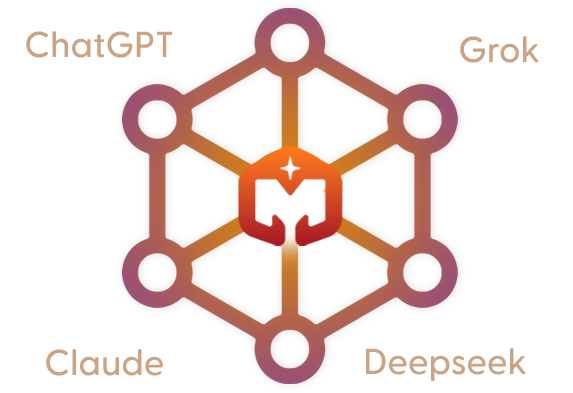
Use ChatGPT, Claude, Gemini, Grok, open models, or other providers without locking your memory inside any one platform.
Route sensitive work to models running on your own device through tools like Ollama or LM Studio when privacy matters more than maximum cloud power.
Connect to user-owned, team-owned, or community-owned compute nodes for more power, shared infrastructure, and reduced dependence on centralized AI companies and Datacenters.
Selectable intelligence
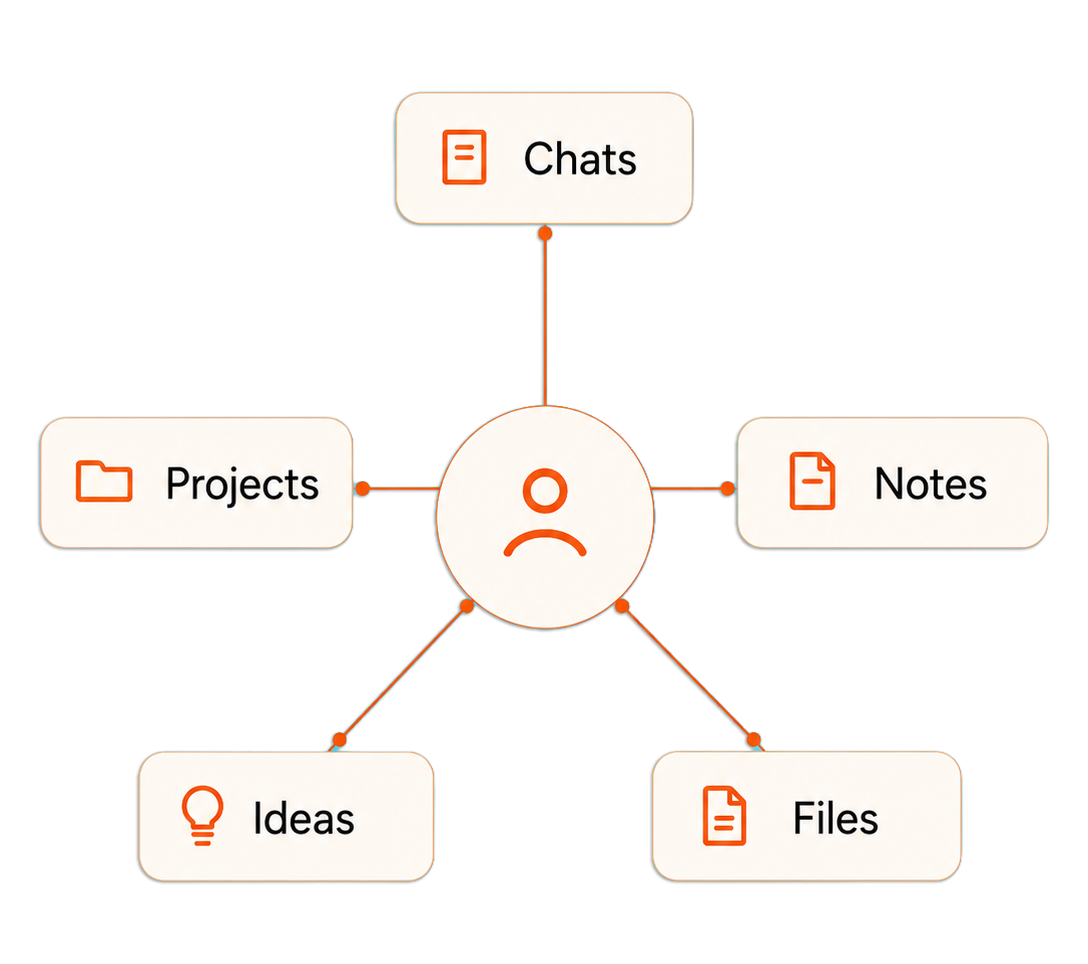
Mana preserves the context that makes AI useful, then lets you route it to the model you choose.
Your memory
Chats, notes, files, projects, and ideas.
AI models
Compare answers. Switch anytime.
Local LLM
Mana analyzes your device capacity, memory needs, and preferred workflows, then suggests the local systems that are most optimal for your intelligence needs.
When a task can run locally, your private memory can stay on your own device while your intelligence keeps evolving over time. This is the pathway to individual intelligence: a model that learns from your private continuity without turning your inner life into platform property.
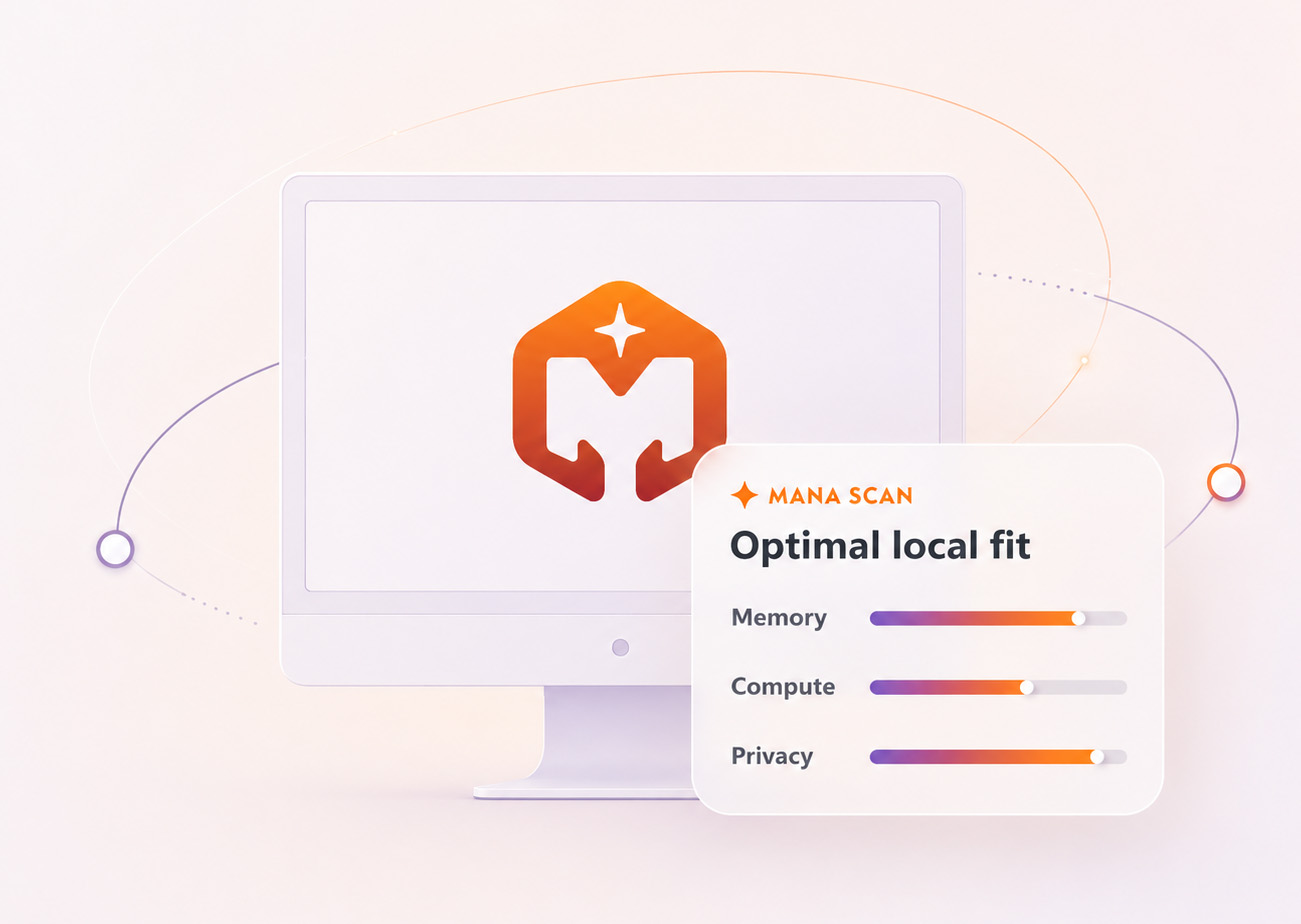
Mana suggests local LLMs that fit your hardware, speed needs, and memory depth.
Only the context needed for the local task is activated from your private memory layer.
Your personal intelligence improves as your memory grows, without depending on one centralized provider.
Private nodes
Mana's Shared Compute lets individuals, teams, and communities pool intelligence infrastructure while keeping memory boundaries visible, governed, and closer to the people who rely on them. Distributed compute and data can reduce dependence on resource-hungry, environmentally destructive mega data centers.
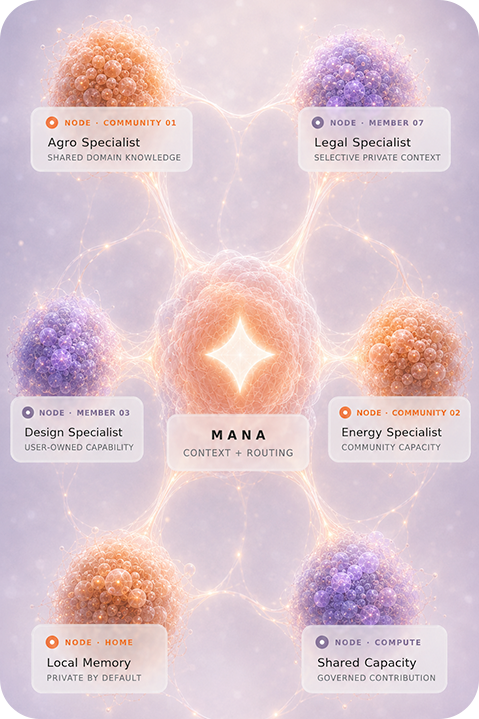
Private nodes can use user-owned, team-owned, and community-owned capacity for stronger models and larger workloads, instead of concentrating every request inside massive centralized data centers.
Mana can route only the selected context a node is allowed to use, so shared infrastructure does not mean exposing an entire personal history.
Private nodes create a path for families, organizations, and communities to build intelligence capacity that reflects their own needs, values, and constraints.
Mana will only become meaningful through the people who test it, question it, contribute to it, and help govern what it becomes.
Build It With Us